

How can megawatt charging move from an emerging technology to a solution that works in everyday logistics operations?
This question was at the centre of MACBETH’s participation in the Green Mobility Exchange 2026 in Amsterdam.
The event brought together stakeholders working across transport, energy and the circular economy to explore the practical challenges and opportunities involved in accelerating the transition towards zero-emission mobility.
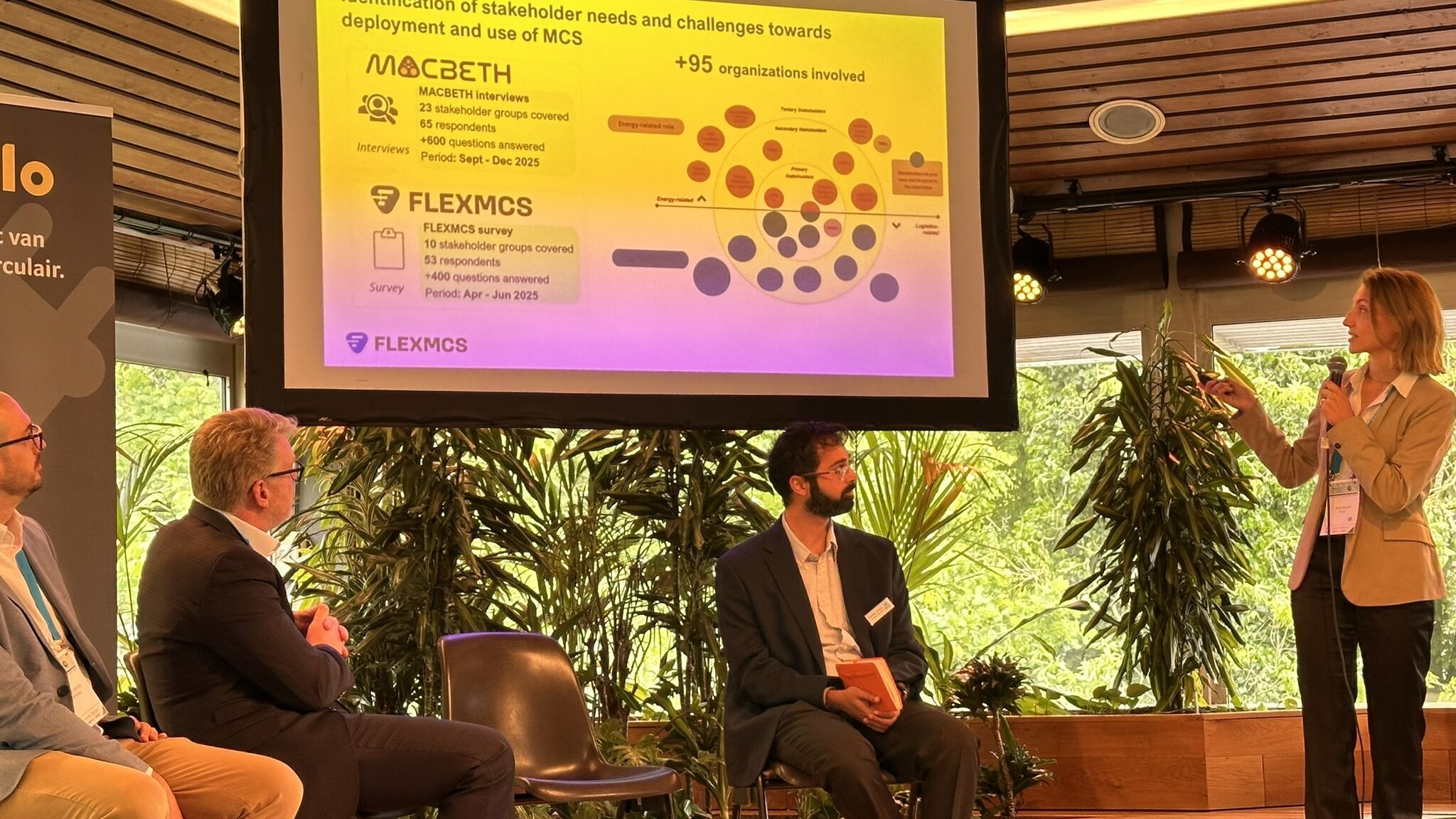
As part of the programme, MACBETH contributed to a seminar dedicated to megawatt charging, bringing the perspective of logistics and freight operators into a discussion that is often focused primarily on technological development.
What does the logistics sector need from megawatt charging?
Megawatt Charging Systems have the potential to play a crucial role in the electrification of long-haul heavy-duty transport.
By enabling significantly higher charging power, MCS could help reduce charging times and make battery-electric trucks more compatible with demanding logistics schedules.
However, discussions during the event showed that faster charging alone will not guarantee successful deployment.
For logistics service providers, the transition towards electric long-haul operations raises a series of practical questions. Will charging infrastructure be available along the routes where it is needed? Can operators rely on chargers being available when they arrive? How will charging fit into delivery schedules and driver operations? What are the financial and operational risks involved in transitioning towards electric fleets?
These were among the questions explored through MACBETH’s contribution.
Alice Scotti from ALICE shared insights from stakeholder engagement activities carried out within MACBETH and FLEXMCS, focusing on the key challenges and blockers identified by logistics service providers as they consider the transition towards battery-electric long-haul transport.
The discussion looked beyond the charging technology itself and focused on what needs to happen for MCS to become a realistic and scalable solution for the logistics sector.
From charging technology to operational reality
The deployment of MCS infrastructure involves a complex set of challenges.
Standards and interoperability will be essential to ensure that vehicles can charge across different locations and networks. Infrastructure will need to be deployed at strategic locations that reflect real freight flows, while grid capacity and connection times will need to support the significant power requirements associated with heavy-duty charging.
At the same time, the infrastructure needs to fit into the operational reality of freight transport.
Truck operators cannot treat charging as an isolated activity. Charging decisions are closely connected to route planning, delivery schedules, driver breaks, vehicle availability and the broader economics of running a fleet.
This is why understanding user needs remains a central element of MACBETH’s work.
The insights shared during the Green Mobility Exchange reflected the importance of involving logistics stakeholders in the development of future charging infrastructure and ensuring that technical solutions are aligned with real operational needs.
A wider conversation on scaling megawatt charging
The seminar brought together perspectives from across the charging and heavy-duty transport ecosystem, creating an opportunity to discuss the different elements needed to scale megawatt charging.
The exchange covered stakeholder needs, infrastructure deployment and the wider challenges associated with developing a charging ecosystem capable of supporting electric long-haul transport.
MACBETH’s participation also formed part of the wider collaboration between European projects working on zero-emission heavy-duty transport.
As Europe moves from individual pilots towards larger-scale deployment, the discussions reinforced the need to develop solutions across the entire system, connecting vehicle technology, charging infrastructure, energy systems and logistics operations.
Bringing stakeholder voices into the transition
For MACBETH, stakeholder engagement is a way of ensuring that the development of future charging hubs takes into account the operational, economic and practical realities of long-haul freight transport.
The Green Mobility Exchange provided an opportunity to bring these perspectives into the conversation and exchange views with stakeholders working across the wider mobility and energy ecosystem.
The discussions demonstrated that the future of megawatt charging will depend not only on technological progress, but also on whether the infrastructure responds to the needs of those who will ultimately use it.
MACBETH was pleased to contribute to this exchange and to continue the conversation on how megawatt charging can become a scalable, reliable and user-centred solution for zero-emission heavy-duty transport.