

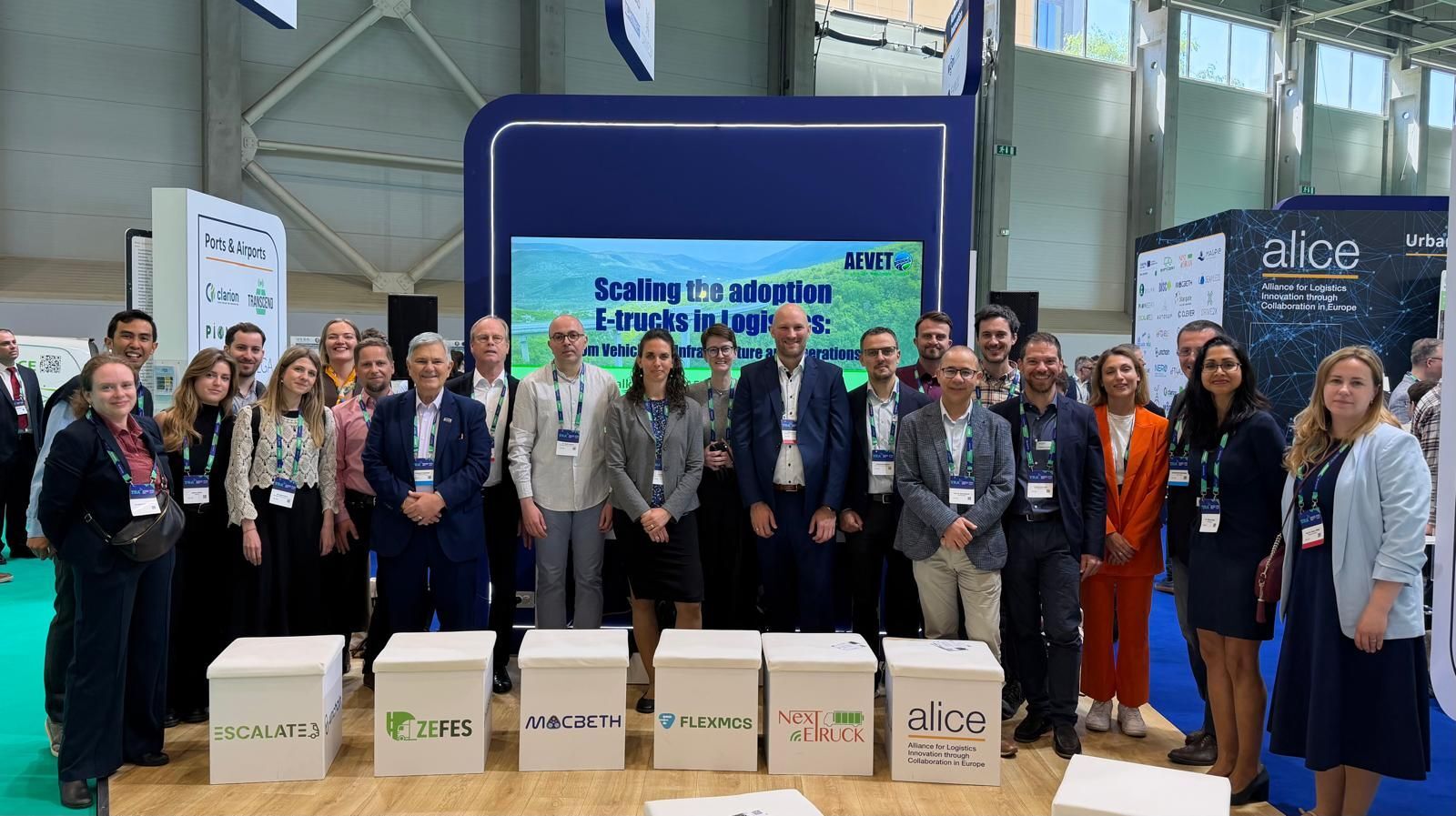
MACBETH headed to Budapest for the Transport Research Arena (TRA) 2026, joining researchers, policymakers, industry representatives and innovators from across Europe to discuss the future of transport.
Taking place from 18 to 21 May 2026, TRA provided an important space to exchange knowledge, share the latest developments and explore the solutions needed to accelerate the transition towards more sustainable and efficient mobility.
For MACBETH, the conversation focused on one of the key challenges facing the decarbonisation of long-haul freight: how Europe can move from promising demonstrations of battery-electric trucks and megawatt charging systems towards large-scale and reliable deployment.
From technological progress to real-world deployment
The electrification of heavy-duty transport is progressing rapidly. Battery-electric trucks are entering the market, charging technologies are advancing, and European projects are testing new solutions in real-world operational environments.
However, discussions at TRA highlighted that deploying megawatt charging infrastructure at scale requires much more than technological development alone.
Infrastructure needs to be available where and when trucks need it. Charging hubs need to respond to the operational requirements of logistics companies, while grid connections, interoperability, standards, business models and user needs all need to evolve alongside the technology.
These were some of the challenges at the centre of MACBETH’s contribution.
The project shared its perspective on the development and demonstration of user-centric, multipoint megawatt charging hubs for battery-electric trucks, combining charging infrastructure with the tools and services needed to support future large-scale deployment.
MACBETH also brought stakeholder perspectives into the discussion. Through its engagement activities, the project has been gathering insights into the challenges, expectations and practical conditions that need to be addressed for MCS to become a viable solution for long-haul logistics.
Joining the AEVETO cluster conversation
MACBETH was also part of the wider conversation taking place across the AEVETO cluster.
The transition to zero-emission heavy-duty transport cannot be addressed by a single technology or project. It requires progress across vehicles, charging infrastructure, energy systems and logistics operations, as well as close cooperation between the projects developing and demonstrating these solutions.
At TRA, MACBETH joined other European initiatives working across these interconnected challenges, including FLEXMCS, ZEFES, ESCALATE and NextETRUCK.
The exchanges provided an opportunity to look at the transition from different perspectives: from the deployment of zero-emission trucks and high-power charging infrastructure to the operational challenges faced by logistics companies and the requirements for building an interoperable European charging ecosystem.
The discussions highlighted the importance of collaboration and knowledge exchange as Europe moves from individual demonstrations towards larger-scale deployment.
Building the ecosystem around megawatt charging
For MACBETH, TRA was not only an opportunity to share the project’s work, but also to engage with the wider research and innovation community.
The successful deployment of megawatt charging systems will depend on the development of an entire ecosystem around them. Trucks, charging hubs, grid infrastructure, digital services and logistics operations will need to work together.
The discussions in Budapest reinforced the importance of bringing together research, industry and logistics stakeholders to ensure that the infrastructure being developed is not only technically advanced, but also practical, reliable and suited to the needs of future users.
MACBETH’s participation at TRA 2026 was therefore an opportunity to both share its work and learn from other initiatives contributing to the transition towards zero-emission heavy-duty transport.